
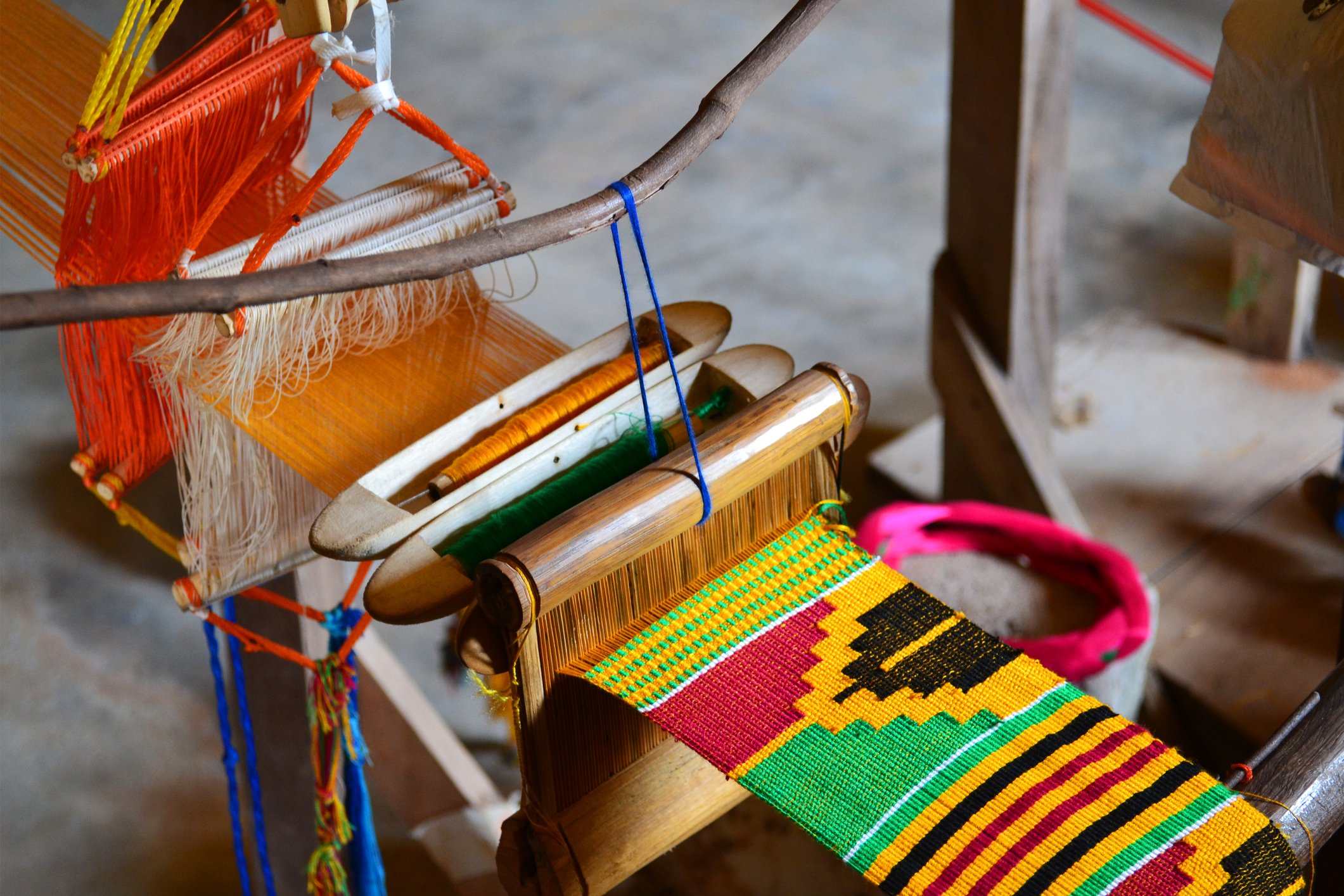
Kente is more than just a piece of fabric. It is a representation of Ghanaian heritage, creativity, craftsmanship and cultural identity. Woven traditionally on narrow looms, Kente has evolved over the years into different styles, designs, patterns and levels of craftsmanship, making it one of the most recognisable traditional textiles from Ghana.
However, one question that frequently comes up when purchasing Kente is: Why do some Kente fabrics cost significantly more than others, even when they appear similar?
The answer lies in the production process. The price of handwoven Kente is not determined by its appearance alone. Several technical and practical factors influence how much time, material, skill and effort go into producing a particular fabric.
Whether you are purchasing Kente for a wedding, a traditional ceremony, a special occasion or personal use, understanding these factors will help you appreciate the value behind the price.
Below are ten important factors that determine the price of handwoven Kente in Ghana.
1. Type of Thread
One of the first things to consider when determining the price of handwoven Kente is the type of thread used in its production.
Generally, Kente weaving involves two major thread arrangements: the warp and the weft.
The warp threads run lengthwise along the loom and, in the weaving framework discussed here, are consistently made from polyester. The weft threads run across the width of the fabric and can be made from different materials, including cotton, rayon and silk (embroidery thread).
Each thread has unique characteristics, costs and levels of difficulty when it comes to weaving. These differences influence both the production process and the final appearance of the fabric.
Let's examine the different types.
Cotton
Cotton is traditionally associated with classic and older styles of Kente. It gives the fabric a traditional textile character and has its own distinctive texture.
However, cotton can be somewhat more difficult to work with than rayon during weaving. Its handling characteristics mean that the weaver may require more attention and effort to achieve the desired result.
Rayon
Rayon is arguably the most popular weft thread used in modern Kente production. It is estimated to account for approximately 70% of the Kente available in the market.
It is a practical, versatile and convenient option for weavers because it is relatively easy to handle during production. Its texture and appearance also make it suitable for producing the colourful and attractive patterns commonly associated with contemporary Kente.
Rayon is therefore the go-to option for many weavers.
Silk (Embroidery Thread)
Silk, commonly referred to as embroidery thread in this context, is among the most luxurious materials used in Kente weaving.
It is smooth and has a glossy appearance that gives the finished fabric a distinctive luxurious feel. It can also produce beautiful reflective and metallic-looking effects.
However, working with this thread is considerably more demanding. It frays easily, requires careful handling and takes longer to weave. This increases the amount of time and effort required from the weaver.
It is also the most expensive of the three main weft options discussed. As a general cost estimate, silk can cost approximately three times the price of rayon.
Polyester
Although polyester is the preferred material for the warp, it is also sometimes used as a weft thread.
Polyester weft is generally the most affordable option. However, its texture and finishing qualities may not be as satisfactory as those of rayon or silk.
Consequently, polyester-weft Kente is often positioned as a more affordable alternative, while rayon-weft Kente generally costs more.
How does this affect the price?
The choice of thread directly influences material expenses, weaving difficulty and the final appearance of the fabric.
Cotton and rayon may fall within a relatively similar price range, although rayon is often preferred for its ease of use. Silk, on the other hand, significantly increases production costs because of its price and the additional care required during weaving.
Therefore, two Kente fabrics with identical designs and lengths may have different prices simply because they were woven using different weft threads.
2. Weaving Method
Beyond the type of thread used, the method employed to weave the Kente is another important factor that determines its price.
There are different weaving techniques used in Ghana, and each comes with its own level of difficulty, skill requirements and production time.
Some of the methods include the block method, heddle method and plain or stripe method.
The Block Method
The block method involves the weaver manually using their fingers to pick and separate the warp threads before passing the shuttle underneath them.
This requires considerable manual coordination, concentration and skill. Because the weaver has to manually pick the threads during the process, it is generally more demanding than the heddle method.
The Heddle Method
Unlike the block method, the heddle method incorporates the design structure into the heddles.
The weaver alternates between the first and second heddles to create the necessary opening through which the shuttle passes. The process is more systematic because the weaver does not have to manually pick individual warp threads each time.
This makes the method relatively easier and more convenient for producing certain patterns.
The Plain and Stripe Methods
Plain and stripe weaving methods are also used in Kente production, particularly for producing simpler fabric structures and stripe arrangements.
Regional Specialisation in Ghana
Different weaving communities in Ghana are associated with particular weaving techniques.
- Volta Region: Associated with the block method.
- Bonwire, Ashanti Region: Known for the heddle method.
- Northern Region: Associated with plain and plain-stripe weaving techniques.
These regional weaving traditions contribute to the diversity of Kente production in Ghana.
How does this affect the price?
An important point to understand is that the same Kente design can be produced using different weaving methods.
For instance, a particular pattern could be woven using either the block or heddle method. Although the finished designs may look similar, the production processes are different.
Since the block method generally requires more manual effort than the heddle method, the time and labour involved may influence the final price.
Therefore, when purchasing Kente, it is worth finding out not only what design was used but also the weaving method employed to produce it.
3. Design Complexity
The complexity of the design itself is another major factor that influences the price of Kente.
This is different from the weaving method. While the weaving method explains the technique used to construct the fabric, design complexity focuses on how difficult the actual pattern is to produce.
Some Kente designs are relatively straightforward and can be woven within a shorter period. Others involve intricate patterns, complicated arrangements, multiple colours and detailed motifs that require greater concentration and technical skill.
Regardless of the weaving method employed, the complexity of the design can significantly influence the final cost.
Additional Techniques Used in Design Production
In some instances, weavers employ additional techniques to achieve specific design effects. These may include:
- Stamping: An additional process used to introduce particular decorative patterns or effects.
- Jolomi (Manual Embroidery): A manual embroidery technique that can be incorporated into the Kente design to achieve specific decorative details.
These techniques may form part of the actual design production process rather than simply being applied as finishing touches.
An Important Distinction About Authentic Kente
Regardless of the additional techniques employed, authentic handwoven Kente must have a woven foundation produced using the traditional Kente loom.
The woven foundation is fundamental to the identity of the fabric. Techniques such as stamping and Jolomi embroidery may enhance the design, but they do not replace the underlying weaving process.
A fabric that merely imitates the appearance of Kente without the traditional woven foundation should not automatically be classified as handwoven Kente.
How does this affect the price?
The more complicated a design is to execute, the more time, skill and effort it may require.
Consequently, a simple Kente design and a highly intricate one can command different prices even when they use the same thread type and weaving method.
4. Number of Yards
The total length of Kente being purchased is another straightforward but important factor that determines its price.
Kente is sold in different lengths, and naturally, the quantity of fabric required influences the final cost.
For instance, a four-yard Kente fabric will generally cost less than a six-yard Kente fabric, assuming they have similar designs, thread compositions and production requirements.
The principle is simple: the more yards of Kente required, the higher the overall price.
However, the price difference is not always determined by length alone. The design, thread type, weaving method and other production factors also contribute to the final cost.
5. Composition of Sets
Another important consideration when determining the price of Kente is the composition of the set being purchased.
Kente is commonly sold in sets, with each set consisting of three pieces. Each piece measures two yards, giving a total of six yards per complete set.
However, not all sets require the same amount of effort to produce. The composition of the three pieces can significantly influence the time, energy and skill required from the weaver.
Consider two examples.
Set A: Three Patterned Pieces
A set comprising three fully patterned pieces requires the weaver to produce intricate designs across all three pieces.
This means more time, concentration and effort are invested in the production process.
Set B: Two Patterned Pieces and One Plain Piece
In another instance, a set may comprise two patterned pieces and one plain piece.
Since the plain piece is relatively straightforward and less demanding to weave, it reduces the overall production effort compared to a set containing three fully patterned pieces.
Although both sets contain the same total length of six yards, their production requirements are different.
How does this affect the price?
A complete set comprising three patterned pieces will generally command a higher price than a set containing two patterned pieces and one plain piece.
This is because the weaver invests more time and effort in producing three fully patterned pieces.
Therefore, when purchasing Kente by the set, do not consider only the total yardage. Pay attention to the composition of the set and the amount of patterned and plain weaving involved.
6. Border Design
The border design is another factor that contributes to the price of handwoven Kente.
Most Kente fabrics come with a border design that complements the main pattern. In many instances, border designs are relatively simple, straightforward and less demanding to produce.
However, some Kente fabrics feature elaborate and complex borders that require additional effort and skill from the weaver.
For example, a Kente fabric may have a relatively popular main design but be paired with an equally elaborate and popular border design.
Essentially, this means combining two significant design elements into one fabric: a distinctive main pattern and a complex border.
Such combinations can increase the difficulty of production and make the fabric more expensive.
On the other hand, a Kente fabric with a simple border design may be relatively more affordable, depending on the other production factors.
How does this affect the price?
The complexity of the border, the time required to produce it and the additional skill involved can all influence the final selling price.
Therefore, when evaluating the price of Kente, it is important to pay attention not only to the main design but also to the border that accompanies it.
7. Finishing
Finishing is another important factor that can significantly influence the final price of Kente.
After the weaving process, some Kente fabrics undergo additional treatments and decorative processes to improve their appearance, presentation and overall quality.
These processes can transform an ordinary-looking woven fabric into a more attractive and sophisticated product.
Some common finishing techniques include:
- Sewing: Joining the individual woven strips together to create a complete piece of fabric.
- Knitting: Additional textile work incorporated into the finishing process.
- Manual Embroidery: Applying decorative embroidery to enhance particular areas of the fabric.
- Digital Embroidery: Using embroidery technology to introduce detailed designs and decorative elements.
- Reflective Gold Applications: Adding reflective golden surfaces or elements to create a luxurious appearance.
- Beading: Incorporating beads into the fabric for additional decoration.
- Painting: Applying decorative colours or artistic details to the woven fabric.
- Embossing: Adding raised decorative elements to create texture and dimension.
Not every Kente fabric undergoes all these processes. The type of finishing depends on the intended appearance, purpose and market positioning of the fabric.
How does this affect the price?
Some Kente fabrics are sold directly after weaving, with little or no additional finishing. While these may still serve their intended purpose, they may not have the same level of visual appeal as fabrics that undergo additional finishing processes.
On the other hand, fabrics that receive professional finishing, embroidery, embellishments and other decorative treatments often require additional materials, labour and technical expertise.
These additional processes increase production costs and can make the finished Kente more attractive and valuable.
Therefore, when comparing two Kente fabrics, it is important to consider whether they have undergone additional finishing and what was involved in the process.
8. Experience and Expertise of the Weaver
Beyond the materials, designs and production techniques, the experience of the person weaving the Kente can also determine its price.
Kente weaving is a craft that requires patience, technical knowledge, creativity and years of practice to master.
An experienced weaver who has spent several years perfecting the craft may have a higher production rate than someone who is relatively new to the profession.
This is because experience often comes with improved technical ability, better handling of different threads, greater understanding of complex patterns and the ability to execute difficult designs with precision.
An experienced craftsman may also be able to interpret unique design requirements and produce more refined results.
How does this affect the price?
The expertise of the weaver contributes to the value of the finished fabric.
A highly experienced weaver may charge more for their work because of the skill, craftsmanship and reliability they bring to the production process.
Similarly, a less experienced weaver may charge a lower rate, particularly when producing relatively straightforward designs.
It is important to understand that when purchasing handwoven Kente, you are not simply paying for the materials. You are also paying for the knowledge, creativity and craftsmanship of the person who produced it.
9. Whether the Kente Is Designed for Men or Women
An additional factor that influences the price of Kente is whether the fabric is intended for men's or women's traditional wear.
In many traditional Kente purchasing arrangements, men's and women's fabrics differ in their required lengths and, consequently, the quantity of material and weaving involved.
Women's Kente is commonly purchased in six-yard sets, while men's Kente may require approximately ten to twelve yards, depending on the intended style and occasion.
This difference in yardage means that producing men's Kente can require significantly more thread, weaving time and labour.
How does this affect the price?
Since men's Kente generally requires more yards than women's Kente, it is often more expensive.
However, this does not mean that every men's Kente is automatically more expensive than every women's Kente. Thread selection, design complexity, weaving method and finishing still play important roles.
The important consideration is the total quantity of fabric required for the intended use.
10. Main Design-to-Border Design Ratio
The relationship between the main design and the border design is another consideration when evaluating the price of Kente.
While the complexity of the main design and border design can be considered separately, their proportion and arrangement within the fabric can also influence the production process.
For example, some Kente fabrics may feature a dominant main design with a relatively narrow and simple border. Others may have elaborate borders that occupy a more significant portion of the fabric.
The amount of weaving dedicated to the main design compared to the border can influence the distribution of patterns, the arrangement of threads and the time required to complete the fabric.
This is particularly important when the main design and border have different levels of complexity.
How does this affect the price?
The relationship between these two design elements can determine how much work goes into producing each section of the fabric.
A fabric with an elaborate main design and an equally demanding border may require more effort than one with a simple main design and a straightforward border.
Consequently, the overall design composition can influence the final price.
Conclusion: Understanding the True Value of Handwoven Kente
The price of handwoven Kente is determined by much more than its colours, patterns or general appearance. It is the result of several interconnected production factors, including the type of thread, weaving method, design complexity, yardage, composition of sets, border design, finishing and the experience of the weaver.
Two Kente fabrics may look similar at first glance but have significantly different production costs because of the materials and techniques used to create them.
This is why understanding the production process is important, especially when purchasing Kente.
At Hinkro Kente, we believe that appreciating Kente goes beyond admiring its beauty. It also means understanding the craftsmanship, creativity, technical knowledge and effort that go into producing every piece.
Whether you are looking for a simple traditional design or a luxurious bespoke Kente creation, understanding these factors will help you make a more informed purchasing decision.
Explore our collection of handwoven Kente and discover the craftsmanship behind every design at Hinkro Kente.