
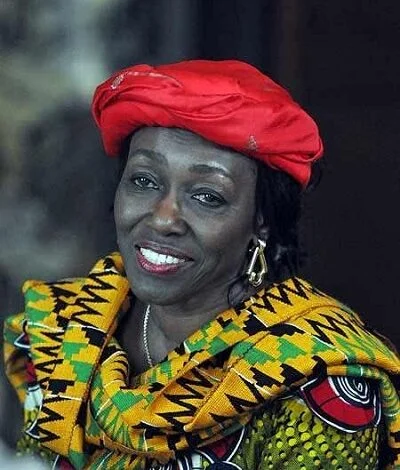
In Appreciation of Nana Konadu Agyeman-Rawlings
Ghana's cultural landscape has been shaped by many remarkable individuals, but few have left an imprint as deep and multifaceted as Nana Konadu Agyeman-Rawlings. As a former First Lady, a pioneering politician, a businesswoman, and a passionate advocate for Ghanaian culture and women's empowerment, her contributions extend far beyond the political sphere. Her legacy is woven into the very fabric of modern Ghanaian identity, much like the kente cloth she has so elegantly championed throughout her public life.
This article is a tribute to Nana Konadu Agyeman-Rawlings and her enduring connection to Ghanaian heritage, with particular emphasis on her relationship with kente cloth and the broader cultural values it represents.
A Life of Purpose and Service
Born on November 17, 1948, in Kumasi, Nana Konadu Agyeman-Rawlings grew up in the heartland of Ashanti culture. From an early age, she was immersed in the traditions, values, and aesthetic sensibilities that would define her public persona. She attended the University of Ghana, where she studied art, a discipline that deepened her appreciation for Ghana's creative traditions.
Her marriage to Jerry John Rawlings, who would become Ghana's head of state and later president, placed her at the center of national life. But Nana Konadu was never content to occupy a ceremonial role. She used her platform to advocate for grassroots development, women's rights, and cultural preservation. Her establishment of the 31st December Women's Movement in 1982 was a groundbreaking initiative that mobilized women across Ghana for economic empowerment, health education, and community development.
Championing Ghanaian Culture
Throughout her years in the public eye, Nana Konadu Agyeman-Rawlings has been a consistent and visible advocate for Ghanaian cultural expression. She has often been seen wearing kente cloth at state functions, international conferences, and cultural events, using her attire as a statement of national pride and identity.
Her choice of kente is never accidental. Each garment she wears is carefully selected to convey specific messages about Ghanaian values, history, and aspirations. By wearing kente on the world stage, she has helped elevate the cloth from a national symbol to an international icon of African excellence and cultural sophistication.
Beyond wearing kente, Nana Konadu has supported efforts to preserve and promote kente weaving as a living tradition. She has advocated for the economic empowerment of kente weavers, recognizing that the survival of this art form depends on the livelihoods of the artisans who practice it. Her support for initiatives that connect traditional weavers with modern markets has helped ensure that kente remains both culturally relevant and economically sustainable.
Connection to Kente and Ghanaian Heritage
The connection between Nana Konadu Agyeman-Rawlings and kente goes beyond aesthetics. Kente cloth is a language, and Nana Konadu has demonstrated a deep understanding of its vocabulary. The colors, patterns, and arrangements of kente cloth each carry specific meanings, and her selections reflect a sophisticated grasp of this symbolic system.
For example, she has frequently worn kente featuring gold and yellow tones, colors traditionally associated with wealth, royalty, and spiritual purity in Akan culture. She has also been seen in kente with blue elements, which represent peace, harmony, and love. These choices are not merely fashionable; they are deliberate acts of cultural communication that reinforce the values she has championed throughout her career.
Her appreciation for kente also extends to its role as a tool for national unity. In a country with over 80 ethnic groups, kente has served as a unifying symbol that transcends tribal boundaries. Nana Konadu has recognized this unifying power and has promoted kente as a shared heritage that all Ghanaians can take pride in, regardless of their ethnic background.
Legacy of Cultural Empowerment
Nana Konadu Agyeman-Rawlings' legacy is not confined to her political achievements. Her greatest contribution may be the way she has modeled the intersection of modernity and tradition. In a rapidly changing world, she has shown that it is possible to embrace progress while honoring heritage. Her public persona embodies this balance, and kente cloth has been a central element of that expression.
She has inspired a generation of Ghanaian women to take pride in their cultural identity and to use that identity as a source of strength and confidence. Young women who see her gracefully draped in kente at international forums understand that African culture is not something to be left behind in the march toward modernization; it is something to be carried forward, celebrated, and shared with the world.
An Enduring Inspiration
In appreciating Nana Konadu Agyeman-Rawlings, we recognize more than a political figure or a cultural icon. We recognize a woman who has consistently used her voice, her platform, and her personal style to uplift Ghanaian culture and inspire others to do the same. Her relationship with kente cloth is a microcosm of her broader legacy: thoughtful, intentional, deeply rooted in tradition, and oriented toward the future.
At Hinkro Kente, we are inspired by leaders like Nana Konadu Agyeman-Rawlings who understand the power of kente as a cultural language. Her example reminds us that every piece of kente we weave carries a story, a message, and a legacy. We are honored to contribute to a tradition that she has done so much to preserve and promote.
As Ghana continues to assert its place on the global stage, figures like Nana Konadu Agyeman-Rawlings serve as beacons of cultural pride. Her legacy will continue to inspire Ghanaians and Africans around the world for generations to come, and kente cloth will remain a visible and cherished symbol of that inspiration.