
Artificial Intelligence (AI) is no longer a futuristic concept. Whether we like it or not, it has come to stay, and its influence is gradually finding its way into almost every industry. From automotive engineering and agriculture to medicine, architecture and manufacturing, AI is changing how businesses operate, innovate and deliver value.
The textile industry is no exception.
As technology continues to evolve, its integration into traditional textile production is something we must anticipate, embrace and approach with an open mind. Rather than shy away from the possibilities AI presents, we must learn how to harness its potential while protecting the craftsmanship, cultural significance and heritage that make our traditional textiles unique.
One area where this conversation is becoming increasingly relevant is Kente production.
AI and the New Era of Kente Design
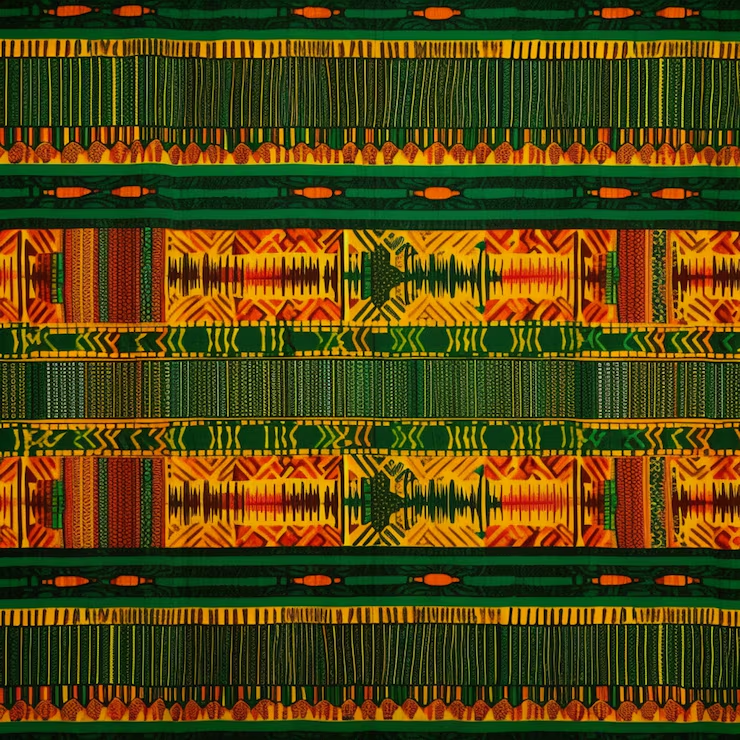
In recent times, there has been a noticeable increase in clients presenting AI-generated Kente patterns, colour combinations and textile concepts to weavers and textile manufacturers.
This is an interesting development, and for good reason.
Artificial Intelligence has introduced new possibilities for creativity. Clients can now explore countless pattern variations, experiment with unconventional colour combinations and visualise textile concepts that may never have occurred to them before.
For the Kente industry, this presents an exciting opportunity. AI can serve as a creative companion, helping designers and clients explore new ideas, reinterpret existing patterns and develop fresh inspirations for contemporary Kente production.
It also makes the design exploration process more accessible. Someone who may not necessarily understand the technicalities of Kente pattern development can use AI tools to communicate a visual idea of what they would like to see woven.
However, as exciting as these possibilities are, there is an important distinction we must understand.
Generating an image of Kente is not the same as generating a technically achievable Kente design.
The Missing Link: Understanding How Kente Is Actually Made
One of the major limitations of AI-generated textile designs today is the accurate representation of how traditional Kente is constructed.
AI image-generation tools can produce visually impressive representations of Kente. They can imitate its colours, patterns and general appearance. However, they do not always accurately understand the underlying weaving structure, textile construction and technical limitations involved in producing an actual piece of Kente.
Kente is not simply a colourful arrangement of patterns. It is a carefully constructed textile made through an intricate weaving process involving specific arrangements of threads, colours, geometric patterns and weaving techniques.
The texture, structure, arrangement and interaction of the threads all contribute to the final appearance of the fabric.
For AI to become even more useful in Kente manufacturing, it must move beyond generating visually attractive images to understanding the actual mechanics of Kente weaving.
Imagine a future where AI can generate a design while considering the available weaving techniques, thread arrangements, geometric structures and practical limitations of the loom. Such technology would make it possible to generate designs that are not only visually appealing but also technically suitable for production.
We are not entirely there yet.
For now, AI-generated Kente designs can serve as valuable sources of inspiration, but they still require the knowledge, experience and technical interpretation of skilled textile professionals before they can become actual woven products.
Three Things Every Client Should Understand Before Submitting an AI-Generated Kente Design
While we encourage creativity and experimentation, clients must understand that an AI-generated Kente image may not always translate directly into a finished woven fabric.
Here are three important considerations.
1. Not Every AI-Generated Pattern Is Geometrically Reproducible
Traditional Kente weaving relies heavily on structured patterns and carefully arranged geometric formations.
However, AI-generated images can sometimes introduce irregular shapes, overlapping elements, gradients and complex visual details that may not be technically achievable through conventional Kente weaving.
A design might look beautiful on a screen but prove difficult, or even impossible, to reproduce accurately on a loom.
This does not mean the entire design must be abandoned. With professional interpretation, certain elements can be adjusted, simplified or reconstructed into patterns that are suitable for weaving.
2. AI Does Not Always Accurately Represent the Texture of Kente
Another important consideration is texture.
AI can generate an image that looks like Kente, but the visual representation may not accurately communicate how actual Kente fabric is constructed or how its threads interact.
The texture, density, arrangement of threads and overall fabric structure are essential characteristics of authentic woven Kente.
Consequently, clients should understand that the finished textile may not look exactly like the AI-generated image, particularly when it comes to texture and structural details.
3. Colour Combinations May Not Always Translate Directly Into Available Weaving Materials
AI tools offer virtually unlimited possibilities when it comes to colour generation.
Clients can experiment with unusual shades, subtle gradients and sophisticated colour combinations that may look exceptional on a digital screen.
However, actual Kente production depends on available yarn colours and the practical possibilities of combining them during weaving.
Some colours may not be readily available in the market, while others may require close alternatives or adjustments to achieve a similar visual effect.
Therefore, the colours displayed in an AI-generated image should be treated as a reference rather than an absolute specification.
A professional consultation helps identify the closest achievable colour combinations without compromising the overall appearance and quality of the intended design.
Why Professional Consultation Matters
The growing use of AI in textile design makes professional consultation more important than ever.
Clients should be willing to receive advice, consider alternatives and remain open to modifications during the design development process.
The objective should not necessarily be to reproduce every pixel of an AI-generated image. Instead, it should be to understand the creative intention behind the design and translate that intention into a beautiful, technically achievable woven textile.
This is where the experience of a professional Kente manufacturer becomes invaluable.
At Hinkro Kente, we recognise the opportunities AI presents and appreciate the creativity it brings to modern textile design. We also understand that turning an AI-generated concept into an actual piece of Kente requires more than simply copying an image.
Our approach involves taking clients through a structured consultation and design development process.
We examine the submitted design, identify the elements that can be reproduced, highlight technical limitations and recommend necessary adjustments. We also consider colour availability, pattern structure and the practical requirements of the weaving process.
Where necessary, we develop and weave a sample for the client to review and approve before proceeding with the full production.
This approach ensures that expectations are properly managed and that the final product reflects the creative direction of the client while remaining achievable through actual Kente weaving.
Our Commitment to Responsible AI Use in Kente Design
As a brand committed to innovation and the advancement of Kente production, Hinkro Kente believes that technology should complement traditional craftsmanship rather than replace the knowledge and expertise behind it.
We welcome clients who experiment with AI and bring us their creative concepts. We believe these technologies can contribute positively to the evolution of Kente, introduce new design possibilities and encourage a new generation of people to appreciate and explore the art of traditional weaving.
However, we also believe in setting clear expectations.
For this reason, we have developed an AI Design Reference Policy to guide clients who submit AI-generated images as references for custom Kente production.
The policy explains our approach to AI-generated designs, what clients should expect, the limitations involved and how we work with them to translate their ideas into achievable woven textiles.
We encourage every client considering an AI-generated Kente design to read the policy before commencing a production project.
Read our AI Design Reference Policy: AI Design Reference Policy
The Future of Kente Is Traditional, Innovative and Open to Possibilities
The conversation around AI and Kente production should not be about choosing between technology and tradition.
It should be about finding meaningful ways to bring them together.
AI gives us new tools to explore creativity, but the knowledge of weaving, understanding of textile structures and experience of skilled artisans remain essential to producing authentic Kente.
As the technology continues to improve, we can anticipate even greater possibilities for pattern development, colour exploration and textile manufacturing.
At Hinkro Kente, we are excited about these possibilities. We believe the future of Kente lies in preserving what makes it culturally significant while remaining open to innovations that can take its design and production to new heights.
Innovation should inspire tradition, not erase it.